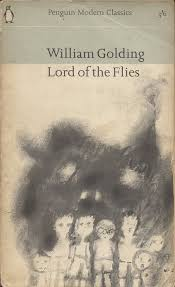
“Lord of the Flies”, by William Golding, is a book that asks the uncomfortable question: “What would you do if there were no rules and no one was watching?” This is a question that is constantly hinted at throughout his novel. He published Lord of the Flies in 1954; even today, after so many years, this book can still lead one to ponder the difference between good and evil.
The book is not just about a group of schoolboys who are stranded on a deserted island; it is a story for all of us. Golding believes that the rules of society are relevant to layers of paint. If the right conditions are met, that paint can peel off. This means that people can become extremely violent and cruel under the right situation.
The idea of “Lord of the Flies” doesn’t sound compelling at first; a group of boys is stranded on an island, and, eventually, chaos breaks out. Golding takes this idea and uses it to show the truth of human nature, to show that people aren’t always morally good, and that even people we think are these amazing, morally perfect humans can commit atrocities. The boys on the island don’t become savages because of the island; the island simply reveals the dark truth about the beast that was already inside of them.
Ralph and Jack are the two clashing forces in the story.
Golding molds and mends these characters by crushing them under the pressure of their own fears and desires. He demonstrates that Ralph isn’t much different from Jack. In reality, they are two sides of the same coin. Their only difference is that Jack gave in to his nature. He gives in to his chaotic side because when he’s on the island, he feels free. He knows there are no rules; he knows that there’s no one to stop him. He forgets about the society and the parents he tried so hard to impress. There, on the island, he could be himself. Ralph, on the other hand, doesn’t want to be an “animal”. He wants to go home to the parents he loves. He wants to eat a warm meal, cooked by his mother’s own two hands. He wants to go back to the world he grew up in because that’s the world he loves.
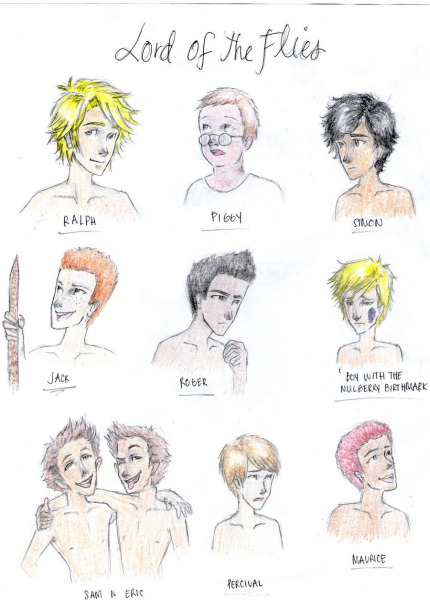
Two other boys play a vital role in the story. One is Piggy, who’s the smartest boy on the island, yet was constantly bullied for his weight and asthma, paired with his poor vision; he is the voice of reason in the story. The other boy is Simon, who’s very quiet, pure, spiritually intelligent, and is the one who understands the truth about the island.
This is not a story about children.
Some people might think that “Lord of the Flies” is just a story about what happens when children are left alone, but the book isn’t just about this crazy story. The book uses symbolism. It’s about people and how they behave when there are no rules. Golding uses children in the story because they are the purest representation of unbiased human nature.
When the COVID-19 pandemic happened, people behaved in ways aligning with the boys on the island. They were scared. They did not work together. They fought over food and masks. This is living proof that adults are mirrors of their younger counterparts. We are all capable of doing horrible, unforgivable things when we are shaken to our core with fear or petrified with terror.

Pahrump Valley High School sophomore, Mia A. Trujillo, says, “Lord of the Flies” is really a reflection of the real world. Now that I think about it, I feel like a lot of things are based on ‘Lord Of The Flies’ terminology. Like a lot of zombie video games and shows rely on the idea of society going nuts after it’s been torn apart. Like how good guys do messed-up stuff just because it’s the end of the world.”
The boys did not become savages because they were on the island. They became savages because that is what people can become when there are no rules, when there’s fear. The children represent a society with no rules and no morals. The children are us; they are the versions of us who didn’t have to behave.
“Lord of the Flies” is not just another run-of-the-mill book to read. It’s not just a story. Golding does not try to make the reader feel comfortable. He tries to make us think about what people are really like when the lights are off; he knows that people are not naturally good. We have to work to fight the evil nature inside of us. The rules and laws that we create are important. They help us to be people, but the rules alone are not enough. We have to try to be good every day, even when no one is watching or when it feels like the chaos is just too loud. We have to try to choose to do the right thing, even when we’re scared, hungry, angry, or when we feel alone on this earth. That’s what makes us human. Not the beast inside of us, but the beast that we fight every day to make the world a better place. Keep fighting that beast.