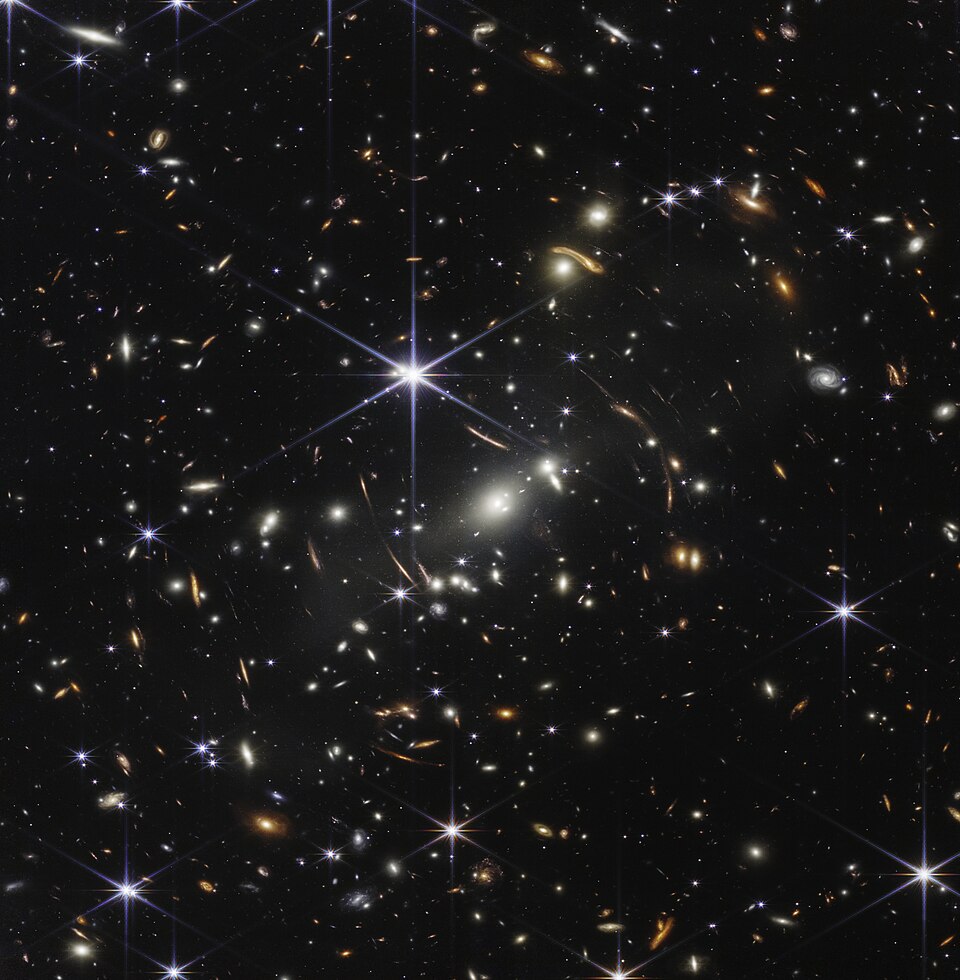
For multiple millennia, mankind’s eyes have been pointed to the sky, pondering its mysteries and what lies beyond. Somewhere between 2000 and 1000 BC, Babylonian astronomers discovered a number of our planets in the night sky. Since then, it’s been a constant discovery, and in the past 100 years, humanity has reached the stars. The cosmos is the next step in human advancement, but what is out there?
Space is incomprehensibly massive; various studies have tried to find some way to rationalize whether the observable universe is everything, or if it continues onward, just too far for the light of faraway astral bodies to reach Earth’s eyes.
As it is known, our solar system is located in the Milky Way, a spiral galaxy approximately 100,000 light-years across. To put light-years into a more easily understood measurement, just one lightyear is six trillion miles. That leaves room for an awful lot of things in our galaxy, home to an estimated 100 billion stars.
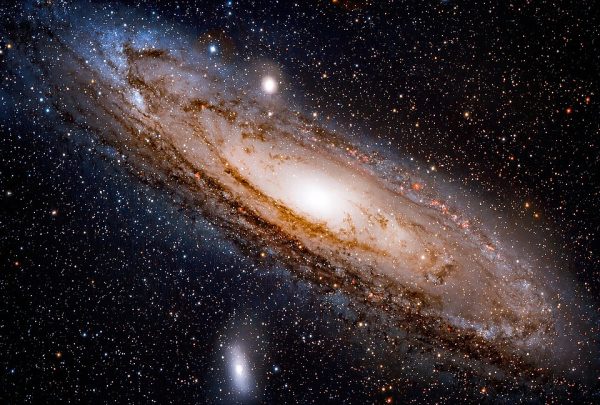
The Milky Way’s closest and largest cosmic neighbor is the Andromeda galaxy, a barred spiral galaxy that is quite far away for being the closest thing to our galaxy, according to the National Aeronautics and Space Administration (NASA). “At approximately 2.5 million light-years away, the Andromeda galaxy, or M31, is our Milky Way’s largest galactic neighbor. The entire galaxy spans 260,000 light-years across…”
Andromeda, being far larger than the Milky Way, is also home to an enormous number of stars, estimated to be in the range of one trillion.
Among the biggest fears in the expanse of the cosmos are the mysterious black holes. Their nature has been explained by NASA as well. “They’re huge concentrations of matter packed into very tiny spaces. A black hole is so dense that gravity just beneath its surface, the event horizon, is strong enough that nothing – not even light – can escape.”
And despite black holes being condensed down matter, they can still be massive. The largest known black hole is TON 618. The event horizon of the super-massive black hole would stretch past Pluto’s orbit around the Sun around 40 times. But it isn’t much of a fear for Earthlings, as it is an estimated ten billion light-years away.
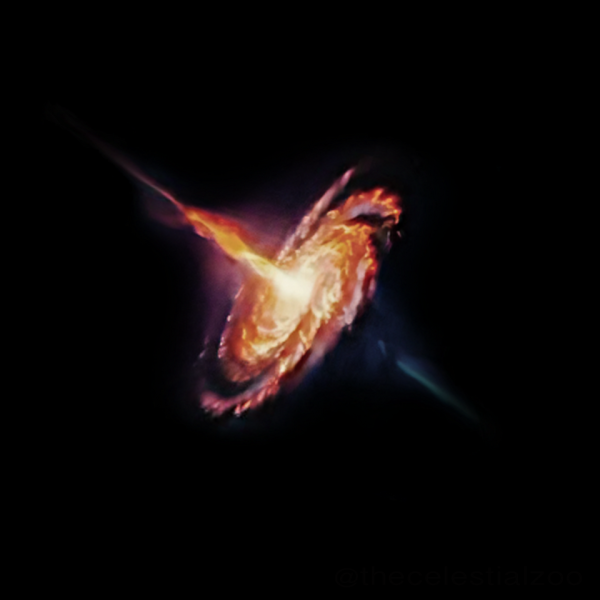
One of the most awe-inspiring objects in the universe is a quasar. Which, according to NASA, are super-massive black hole-fueled galaxies. “They are distant galaxies whose incredibly bright cores are powered by supermassive black holes. Quasars have been found with luminosities between 10 to 100,000 times that of our Milky Way galaxy, generated from an area just a few light-days to a few light-years across.”
Due to extreme gravity in the core, quasars fire out jets of scorching hot material into the universe. In our universe, it’s the closest thing to a planet-destroying Death Star laser from “Star Wars.” Quasar 3C273’s jet was recorded to be over ten trillion degrees, and all jets move faster than the speed of light.
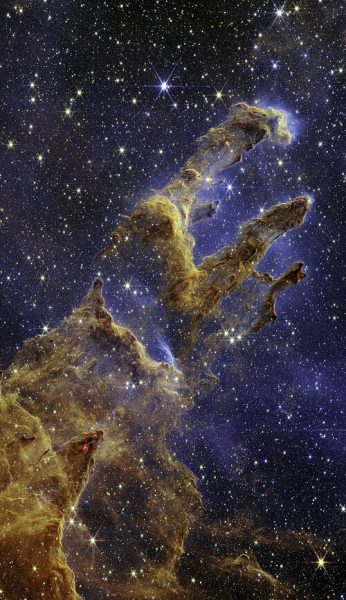
But space isn’t all galaxies and dangerous black holes. Some of the finest scenery is the gas clouds throughout the cosmos. The most well-known being the aptly named Pillars of Creation, which are rich with the components for star formation.
Some may wonder how such great pictures, filled with such vibrant color, manage to be taken. The pictures captured initially by space telescopes are initially rather dark, but are then run through color filters to be applied in a full image. This step has been broken down by NASA. “STScI’s imaging specialists carefully assign individual images from Webb’s various filters to blue, green, and red color channels to align with the color palette human eyes perceive.”
Granted, we can still see illuminated objects like stars and planets, because one emits light and the other reflects it.
But due to the vastness of the cosmos, some objects out there are blurry on our instruments, thus requiring artists to make recreations of what blurry splotches cameras capture, such as the previously mentioned quasars, as well as high-quality looks at black holes.
Space is humanity’s final, unending frontier of unlimited possibilities. Right now, with moving people, we’re rather limited to our own Moon, and in the 2030’s, potentially Mars. But we’re learning so much about the cosmos with our probes and telescopes, that it seems likely, one day, humanity as a species will reach beyond the confines of our own solar system, and find other habitable planets. The future for space exploration is looking very bright.