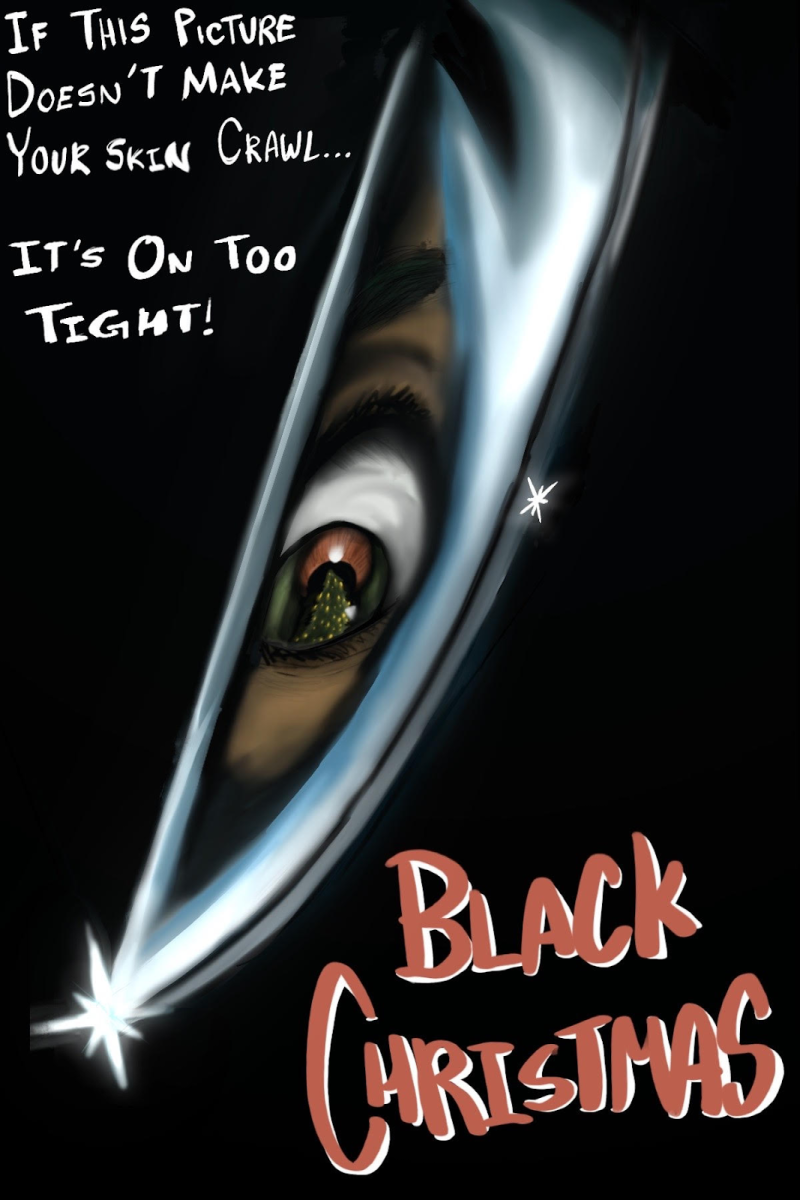
Seasonal horror movies are something we’ve grown accustomed to over the years, with hit movies like John Carpenter’s “Halloween” and George Mihalka’s “My Bloody Valentine”. These types of movies are often credited to Halloween. But there’s a hidden gem that inspired Halloween and the movies after that, which is Bob Clark’s “Black Christmas”. A few things that can be attributed to “Black Christmas” for its involvement in “Halloween” are the first-person POV and the idea of a killer invading a space that you would think is safe, instead of your main characters going into a spooky graveyard or an old castle like in “Dracula” 1958. The sophomore English and film studies teacher, Mrs. Bailey, explains, “‘Black Christmas’ was able to really set the tone for slasher films. The concept of hiding, the phone calls that happen within the house, is really similar to the scene we are familiar with in the movie ‘Scream’, when Drew Barrymore answers the phone. Another similarity we get from ‘Black Christmas’ is the point of view of the killer. This was a new element established in this film that took off in many other horror films.”
“Black Christmas” is one of those movies that has gotten more appreciation over the years. Although it’s not unknown, it’s still wildly underrated. It’s the kind of movie you watch when doing research on slasher movies and looking into that genre. Along with that, it’s also just one of the greatest examples of tension and slow suspense that you can find in the genre. A senior student, Nathan Dodge, remarked, “I think movies like ‘Black Christmas’ were the kinds that popularized the slasher genre to begin with. I think a lot of people enjoyed the anticipation and suspense that came with those types of movies,” Dodge continued.

This is awonderfully crafted film with an understanding of suspense and delivery, a good atmosphere, and it has a final scene that left me soaking in the feeling of it all afterwards. But that’s not all. Like “The Texas Chainsaw Massacre”, which was released the same year, “Black Christmas” isn’t just a movie made to be scary. It has something to say, especially during the time that it came out. One of the topics included, that being abortions, was a very controversial one. Pretty bold of them to comment on a subject like that in 1974.
There are two types of Christmas horror movies: those that happen to take place around Christmas time and those that could be considered Christmas movies. Though I don’t recommend you watch one if you’re looking for the jolly spirit of Christmas. “Black Christmas” falls into the former because it strays away from what you expect to see, like in “Krampus,” where a family loses the Christmas spirit, and at the en,d they learn the true meaning of the holiday. Not so much the case here with this film.
This movie fits right into this time of year for different reasons. Firstly, the setting. In each frame of this movie, you can see something Christmas-related. The decor sets out that gives you a warm feeling in your belly and the urge to cozy up with some blankets and hot chocolate. What really stands out to me is the vibrancy of the lights and the festive decorations scattered around the sorority house this takes place in. It’s a deep contrast to what people from that time expected out of a horror movie. Maybe what we might expect now. For a dark movie, the color palette is so comforting and relaxing. It puts you at ease for what’s to come.
Secondly, there’s the soundscape. Lots of it is what you might expect, with sharp sounds when something intense happens or an eerie piano riff. That piano ties into another character, very important to our story, the main girl’s boyfriend who is framed to be the killer. Both by the movie and by the actual killer himself. The piano parts, distorted and ominous, are used to misdirect the viewers into believing what the characters in the movie think, too.
Lastly, the atmosphere. What makes it such a masterpiece in regard to the tension and suspense displayed is the tone. The film is very quiet, almost dreamy or distant, given how the tech capturing that was at the time. In most horror movies before then, they usually had the characters leaving the safety of their home to go somewhere more isolated. A good example of that is Psycho, released in 1960. Usually, these places would have the characters be stuck there, with no escape. What makes “Black Christmas” different from that is the fact that the murder spree takes place in the home of some college girls, where the killer is inside the house, living there, and picking them off one by one. Bailey puts it like this: “There are different types of horror films, and I think the most scary are the ones that can actually happen in real life.” Bailey explains, “They always take place in everyday places and are linked to everyday people we interact with, or at least could interact with.”

What makes it more agonizing for the viewer is that we know that the killer is in there with them, thanks to the first-person POV we get from time to time of the killer creeping about the attic and the house; it makes you want to scream at the characters to no avail. Emily Olds, a freshman student here, puts it like this: “In ‘Black Christmas’, the faceless killer cliche and taunting of victims was done in a grossly good way. It was unsettling, and I believe it is one of the best ‘the call is coming from inside the house’ type of movies…But you can’t talk about cliches without mentioning how violence towards, usually young, women is glamorized in these types of movies.”
Another aspect of the atmosphere built up is the mystery. At the end, we don’t get an answer to the fates of the final girl and the killer himself. Just a slow shot from the hallways to outside the house, then the credits roll. Olds says this, “I love how the movie’s ending leaves you unsettled. You know that Jess isn’t safe, but it doesn’t give you all the satisfaction of an all tied together ending, the way other movies do.”
Overall, “Black Christmas” (1974) is a work of art that served to boost the slasher genre to grow into what we know today. Hence the loving nickname “The Mother of all Slashers.” Through my gushing, I hope that it will inspire you to watch this work of art because it did so much for horror movies