Eighty miles to the Northwest of Pahrump rests the remains of the ghost town of Rhyolite, established in 1905 after prospectors Frank Harris and Ernest Cross quite literally struck a gold mine in the mining district now known as Bullfrog. But by the mid-1910s, the town’s population went from a peak of over 10,000 to a meager 14.
Rhyolite was amongst many gold towns to spring up like desert cactus across the state from the mid-1800s to the early 1900s. Harris and Cross’s discovery of gold-rich quartz in the region led to a massive influx of people seeking out their own fortune. And due to that abundance, the town of Rhyolite was established nearly in the very center of Bullfrog, perfect for the proximity to the vast other mines in the region.
In 1906, the great potential of wealth in the region would capture the eye of Bethlehem Steel Corporations’ owner Charles Michael Schwab, who would buy the entirety of Bullfrog, and establish a deal for railroads to hookup to Rhyolite as provided by Travel Nevada. “In 1906, Schwab purchased the Bullfrog Mining District, which elevated the operation from good to grand. With Schwab’s leadership, Rhyolite secured a contract with the Las Vegas and Tonopah Railroad, and within a year, three railroads were connected to Rhyolite’s brand-new—and still perfectly preserved—train station.”
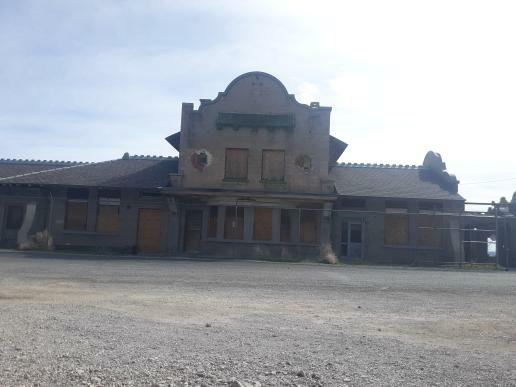
In 1907 electricity would be brought to the town, allowing for a mill to be built at the Montgomery Shoshone Mine to the Northeast of Rhyolite. “And by August of that year a mill had been constructed to handle 300 tons of ore a day at the Montgomery Shoshone mine. It consisted of a crusher, 3 giant rollers, over a dozen cyanide tanks and a reduction furnace. The Montgomery Shoshone mine had become nationally known because Bob Montgomery once boasted he could take $10,000 a day in ore from the mine,” according to the National Park Service.
But it seemed the promise of gold in Bullfrog was a brief one. In 1907, Rhyolite was struck by the Financial Panic which was the worst money crisis of its time, until the Great Depression. Despite being a situation far east, it reached the west, and many of the bank companies in Rhyolite would close. The following year, a fire would claim a chunk of the town, leading to its downward spiral detailed by Nevada Expeditions: “On August 19, a fire leveled the red light district and parts of the eastern business district. By the end of 1909, less than 1,000 people were left. The Montgomery-Shoshone mine closed permanently in March 1911.”
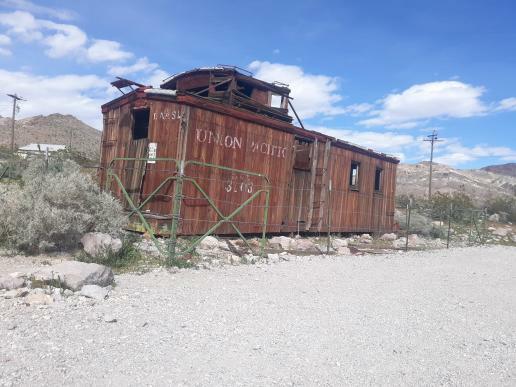
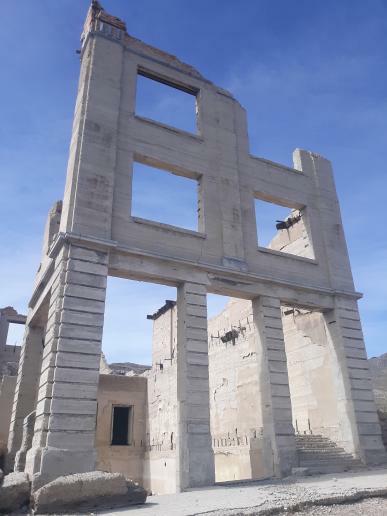
Rhyolite’s last residents would vacate in 1924, leaving it completely abandoned. Today, the vast majority of its structures are completely gone, or are crumbling aside from the well preserved Train Station. But, even today as a national park it is boarded up and fenced off, and all of the railroads that connected to Rhyolite were stripped over 100 years ago. Funnily enough, one of the more intact structures is Rhyolite’s jailhouse. Whilst the front of the building has crumbled, the back of the building and presumably its holding cells remain completely intact thanks to an iron construction.
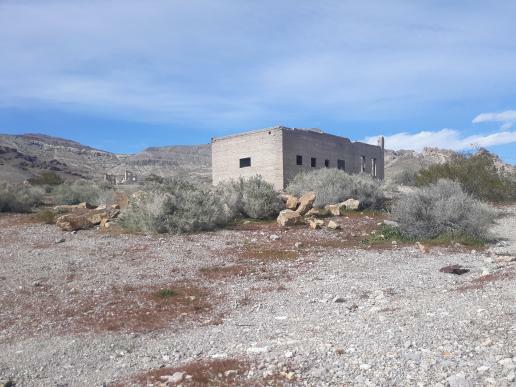
Rhyolite is a ruin today, but is a looking glass into Nevada’s rich history of early western culture and prospecting. It serves as a good tourist spot for those in search of ghost towns to sight see. And for curious residents of Pahrump, it can serve as a good day in and out trip thanks to its proximity. Just be sure to bring a bit of water for the scorching sun.