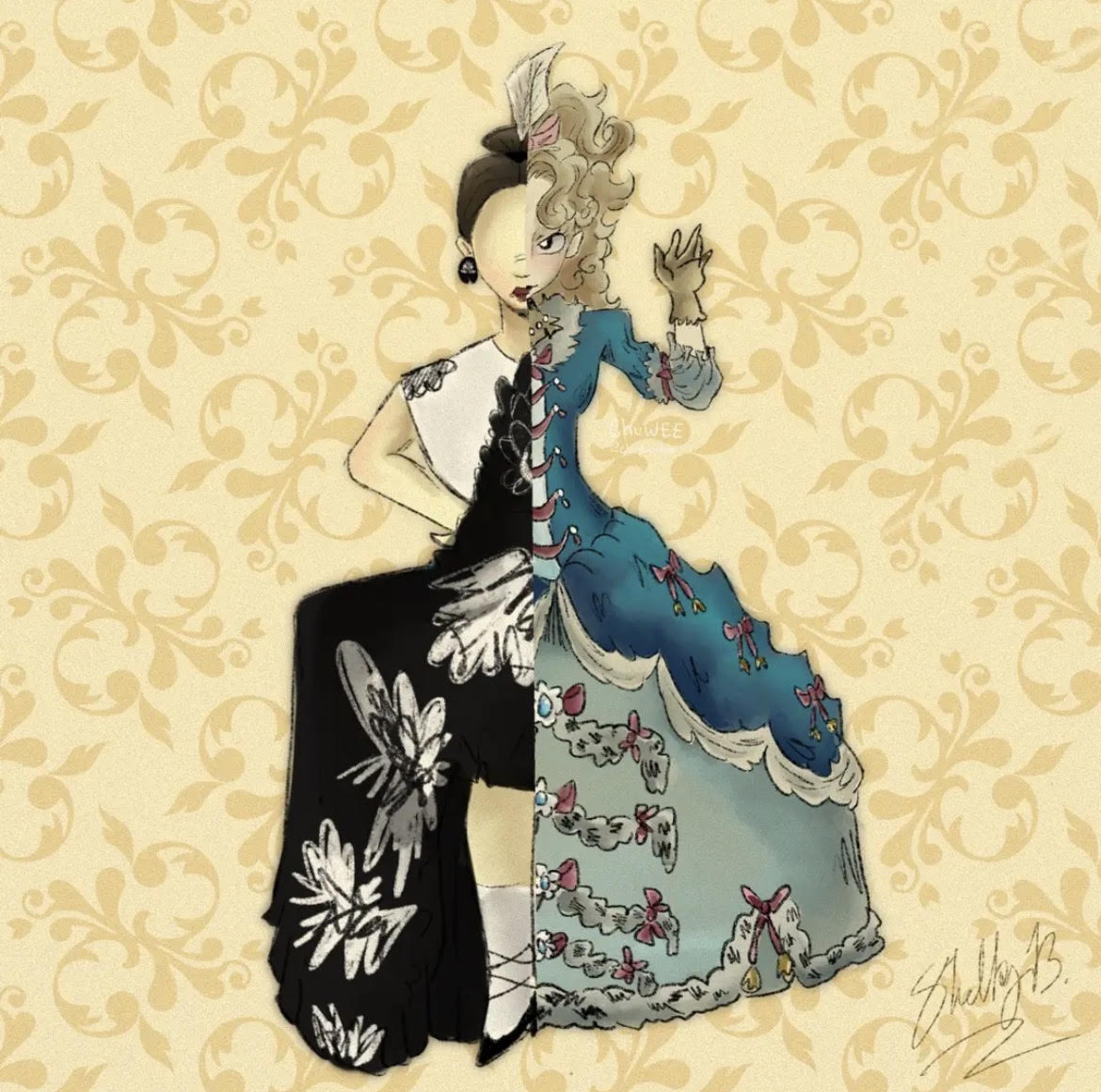
“The Devil Wears Prada”, a 2006 film, follows the story of a journalist carving her future in New York whilst working for the editor-in-chief of a fashion magazine. The following Oscars put the best movies released head to head for the best costuming award; all these movies being period pieces except for one. Critiques increased ten-fold, debating whether or not “The Devil Wears Prada” is a worthwhile fashion movie.
David Frankel’s 2006 film,“The Devil Wears Prada”, introduces a young journalism student working in New York for the tyrannical editor-in-chief of a fashion magazine. Like most 2000s films, she starts as a dowdy nobody, turns into a somebody, and finally simmers down to a perfect in-between. The film uses fashion to convey the message throughout, earning varying critiques. Many are either too little or too much. The Oscars held the following year nominated Sofia Coppola’s “Marie Antoinette” and other period pieces for best costuming, standing out as the only non-historical movie there, and that being “The Devil Wears Prada”. This raises the question: do people prefer historical costuming over contemporary styles? Which one is better?

“I prefer historical fashion over modern. It has more charm to me, more depth. It’s simply nicer to look at compared to newer things. Like Kanye West’s line, it just looks boring. Rococo and regency trends are cooler.” Emily Olds, a freshman student at Pahrump Valley High School, answered this question, sharing similar views as other interviewees.

In an interview I conducted with the film studies teacher, Charlena Bailey, she made this point: “Fashion always repeats itself and you see that clearly in period pieces and modern movies alike. It’s prominent in period pieces because you can see the dress back then and compare it to the now.” She explained. “You wouldn’t have modern fashion without the stuff from period pieces, would you?”
Throughout the movie, we see our main character develop with styled looks from popular brands like Chanel, Prada, Dolce & Gabbana, and Calvin Klein. That comes to a head in the elegance of the editor-in-chief, Miranda Priestly. We see her fashion look spread to our heroine and practically everybody else in the movie. The reviews on this aspect vary from too much to too little. Some view the use of luxury brands and accessories as superficial and unrealistic, while others think fashion is underwhelming compared to movies that released that same year like, “Dreamgirls” and “Curse of the Golden Flower”. To quote Kathleen Fasanella at Fashion Incubator, “Contrary to the film’s depiction, wearing fur is becoming more uncool every day (hence their need to promote their side of the industry).” She describes in her review an out-of-touch overuse of fur and other extra pieces despite the fashion industry moving away from fur at the time. She also commented on the lack of realism: “However, in real life, fashion workers are more likely to dress like Andi and her friends than not. We dress terribly.”
Bailey had a different interpretation of this: “I don’t think the film did the best job on the fashion part but rather portraying the industry. They stayed true to real life in that aspect.”
“I think the movie was made to encapsulate the fashion industry rather than fashion itself. I think it portrays how these people work in the industries. That’s the moral sacrifice. The fashion is amazing but it all has another meaning behind it.” Bailey continued.
However, Patricia Field, the designer for “The Devil Wears Prada.” stated the following, “I’m not making documentaries,” in an interview with Ruth La Ferla at The New York Times. In multiple articles in different publications, she defended her creative decisions, saying that she focused more on character development rather than what people wanted, as shown in her famous battle to give Meryl Streep white hair in the movie. She wanted parts of the film to be out of this world, like Priestley was shown to be, while Andrea Sachs made the connection between that world and the real one with her varying style.
Olds agreed with this take: “I think “The Devil Wears Prada” is a very opinionated film, fashion wise. It shows what you should wear and what is acceptable. Like ‘Marie Antoinette’ it’s extravagant and out there, but it isn’t too in your face. It fits the narrative since Miranda Priestly is a rich fashionista.”
“Movies are meant to be enjoyed, unless they’re a documentary or something, then you shouldn’t take them too seriously.” She added.
“Marie Antoinette” similarly uses clothing. Despite taking place in the mid to late 1700s, we see converse shoes, modern fashion magazines, a lack of corsets, and minimal makeup. To call back to Fasanella’s critique on the realism of the movie, does that sound very realistic? But both movies use costuming to convey something, contradicting critics’ takes on realism and extravagance.
“I think the wigs in “Marie Antoinette” pulled the ruffled outfits together, it’s big and bright. Though I doubt all of it was accurate.” Olds remarked.
In response to the realism critiques against the movie, Bailey had this to say: “I think people like period pieces more because of the whimsicality. Nowadays, things are dull and we lack that whimsy we see in movies based around old things. These movies, with their fashion, we’re brought into a fairytale. We attach ourselves to period pieces because we want that whimsy.”
Creative choices in fashion keep films and shows interesting. At some point, you have to tell yourself to put aside real life and indulge in the world being shown to you. What’s life without some fun and unreasonableness? It’s up to you to decide what you like, but it’s also your decision whether or not you’ll give something a chance.